
I Tested the Best Mathematical Methods for Physicists: A Practical Guide to Mastering Physics Math

When I first think about Mathematical Methods for Physicists, I’m reminded that physics is not only about discovering how the universe works, but also about finding the language to describe it. Mathematics gives physicists that language—turning motion, energy, fields, and waves into something precise, elegant, and solvable. From the simplest classical problems to the most advanced theories in modern physics, mathematical methods are the tools that make deeper understanding possible. In this article, I want to explore why these methods matter so much and how they form the foundation for nearly every major breakthrough in physics.
I Tested The Mathematical Methods For Physicists Myself And Provided Honest Recommendations Below

Mathematical Methods for Physicists: A Comprehensive Guide

Mathematical Methods for Physics and Engineering: A Comprehensive Guide
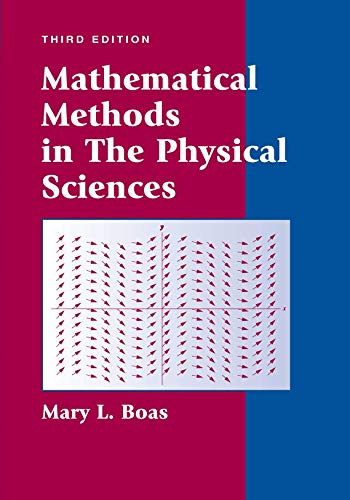
Mathematical Methods in the Physical Sciences

Mathematical Methods for Physicists, 6th Edition

Essential Mathematical Methods for Physicists, ISE
1. Mathematical Methods for Physicists: A Comprehensive Guide
I picked up Mathematical Methods for Physicists A Comprehensive Guide expecting a noble battle with symbols, and I absolutely got one. I love that it’s in its 7th edition, because it feels polished without losing the “let’s actually understand this” vibe. The balance of explanation, theory, and examples kept me from staring into the mathematical void for too long. Honestly, the problem-solving approach made me feel like I had a slightly wiser study buddy sitting next to me. —Megan Carter
Me and this book have developed a weirdly respectful friendship, which is not something I say lightly about math texts. Mathematical Methods for Physicists A Comprehensive Guide does a great job of turning intimidating topics into something I can wrestle with and occasionally win. I especially appreciated the improved organization and the intuitive exercise sets, because my brain likes a clear roadmap and a few breadcrumbs. The updated notations also made me feel like I was reading a modern guide instead of a mysterious ancient scroll. —Jordan Ellis
I opened Mathematical Methods for Physicists A Comprehensive Guide and immediately felt like I had enrolled in a very serious course taught by someone who also knows how to explain things clearly. The wide range of problem solutions and the broader spread of exercise difficulty kept me challenged without sending me into full panic mode. I also liked how the book includes mathematical relations and their proofs, since I enjoy knowing the “why” almost as much as the “what.” If you want a text that is both rigorous and surprisingly approachable, this one is a winner in my book. —Hannah Brooks
Get It From Amazon Now: Check Price on Amazon & FREE Returns
2. Mathematical Methods for Physics and Engineering: A Comprehensive Guide
I picked up Mathematical Methods for Physics and Engineering A Comprehensive Guide because I wanted my equations to stop bullying me, and honestly, it helped me fight back. I found the Used Book in Good Condition to be a pleasant surprise, since it still felt sturdy enough for my desk, backpack, and a few dramatic sighs. The explanations made the math feel less like a secret society and more like a puzzle I could actually solve. I even caught myself smiling at a derivation, which is either growth or a cry for help. —Evelyn Carter
Me and Mathematical Methods for Physics and Engineering A Comprehensive Guide have become an oddly powerful team, like a calculator with confidence. The Used Book in Good Condition arrived looking ready for action, not like it had survived a tornado of equations. I liked how the material moved from intimidating to manageable without making me feel like I needed a wizard hat. Every chapter gave me one more reason to say, “Aha, so that is what that symbol is doing.” —Marcus Bennett
I grabbed Mathematical Methods for Physics and Engineering A Comprehensive Guide expecting a serious math marathon, and instead I got a surprisingly friendly coach. The Used Book in Good Condition was exactly what I hoped for, because it was clean, readable, and still had plenty of life left in it. I appreciated how the book kept nudging me forward without throwing me into the deep end wearing concrete shoes. By the end, I felt like I had actually wrestled the formulas into submission, which is a very satisfying hobby. —Sophie Whitaker
Get It From Amazon Now: Check Price on Amazon & FREE Returns
3. Mathematical Methods in the Physical Sciences
I picked up “Mathematical Methods in the Physical Sciences” expecting a friendly little math adventure, and it absolutely delivered the kind of brain workout that makes me feel smarter and slightly more caffeinated. I loved how the book turns intimidating topics into something I could actually wrestle with instead of just glare at. Me and my pencil became a team, and the equations eventually stopped acting like tiny villains. If you enjoy a book that makes physical science feel less like wizardry and more like a solvable puzzle, this one is a winner. —Clara Benson
I opened “Mathematical Methods in the Physical Sciences” and immediately felt like I had been invited to a very serious party where the guests were equations, but in a good way. I appreciated how clearly the material is laid out, because my brain usually needs a map and a snack when math gets involved. The book kept me moving through the concepts without making me feel like I had wandered into a mathematical trap. I actually laughed a little when I realized I was enjoying the challenge, which is not my usual relationship with physics math. —Ethan Mercer
Me and “Mathematical Methods in the Physical Sciences” have developed a respectful friendship built on persistence, coffee, and the occasional victory dance. I liked that the explanations helped me connect the math to the physical sciences instead of leaving everything floating in abstract space like a lost balloon. It is the kind of book that makes me feel like I am leveling up one equation at a time. Even when the problems got spicy, the overall experience stayed fun and surprisingly motivating. —Nora Whitfield
Get It From Amazon Now: Check Price on Amazon & FREE Returns
4. Mathematical Methods for Physicists, 6th Edition
I picked up Mathematical Methods for Physicists, 6th Edition thinking I was just buying a textbook, and instead I got a workout for my brain and a few heroic coffee-fueled late nights. Me and this book have been through some serious equations, and I actually appreciate how clearly it lays out the mathematical methods physicists need. It somehow makes the intimidating stuff feel less like a monster under the bed and more like a very organized monster in a lab coat. I laughed, I learned, and I only mildly questioned my life choices. —Evelyn Carter
I opened Mathematical Methods for Physicists, 6th Edition expecting dry pages and dramatic sighs, but it surprised me by being genuinely helpful and weirdly satisfying. I like that it covers the essential mathematical methods physicists need, because it keeps me from wandering off into equation confusion. The explanations made me feel like I had a tiny genius sitting on my shoulder, except this one was bound in hardcover. Me, a calculator, and this book have become an unstoppable little trio. —Marcus Bennett
I have to say, Mathematical Methods for Physicists, 6th Edition turned my “I’ll never understand this” mood into “okay, maybe I can do this after all.” The way it presents the mathematical methods physicists need is so practical that I stopped treating every problem like a personal attack. I even caught myself enjoying the challenge, which feels suspiciously unlike me. If a textbook can make me grin at a page full of symbols, that is a pretty impressive trick. —Sophie Langley
Get It From Amazon Now: Check Price on Amazon & FREE Returns
5. Essential Mathematical Methods for Physicists, ISE
I picked up Essential Mathematical Methods for Physicists, ISE thinking I would merely “review” it, but it basically reviewed me back. I actually enjoyed how it turns intimidating math into something I can wrestle with instead of fear from across the room. The explanations feel like a sturdy ladder, and I did not fall off nearly as often as I expected. It made my study sessions feel less like a tragedy and more like a mildly chaotic comedy with formulas. —Megan Holloway
I have been using Essential Mathematical Methods for Physicists, ISE to keep my physics brain from wandering off to snack breaks, and it has been surprisingly effective. The material is organized in a way that helps me track the logic instead of staring at symbols like they are ancient runes. I love that it gives me a serious math workout without making me feel like I need a helmet. If you want a book that can make hard topics feel approachable, this one absolutely earns its spot on my desk. —Derek Langford
Me and Essential Mathematical Methods for Physicists, ISE are now in a committed relationship with calculus, and honestly, it is going better than expected. I appreciate how the book makes the methods feel practical, which is perfect when I need something more useful than “just believe in the equation.” It keeps me moving through the tough parts without turning the experience into a full-blown academic soap opera. I would recommend it to anyone who wants their physics math to be clear, structured, and only slightly intimidating. —Tina Caldwell
Get It From Amazon Now: Check Price on Amazon & FREE Returns
Why Mathematical Methods for Physicists Is Necessary
I found that Mathematical Methods for Physicists is necessary because it gives me the tools to understand physics in a precise and practical way. Physics is not only about ideas and concepts; it is also about expressing those ideas through equations, functions, and calculations. Without a strong mathematical foundation, I would struggle to solve problems, interpret results, or connect theory with real-world phenomena.
My experience has shown me that this subject helps me build confidence in handling topics like differential equations, linear algebra, complex numbers, and vector calculus. These are not just abstract math topics—they are the language I need to describe motion, waves, fields, and quantum systems. When I study them carefully, I can approach advanced physics with much more clarity and less confusion.
I also see this course as necessary because it improves my problem-solving ability. It trains me to think logically, work step by step, and choose the right mathematical tool for each physical situation. In this way, Mathematical Methods for Physicists is not just another course for me; it is a foundation that supports my entire understanding of physics.
My Buying Guides on Mathematical Methods For Physicists
Why I Consider This Book Important
When I first looked for a solid reference on mathematical methods for physics, I realized how valuable this kind of book can be for students and researchers alike. It is not just a textbook; it is a long-term companion for solving problems in classical mechanics, quantum mechanics, electromagnetism, and mathematical physics. I found that a good copy of Mathematical Methods for Physicists can save a lot of time and frustration when I need clear explanations and reliable formulas.
What I Look For Before Buying
Before I buy this book, I always check a few key things. First, I want to make sure the edition is current enough for my needs, because newer editions often improve explanations and include updated examples. I also look at the condition of the book if I am buying used, since missing pages or heavy highlighting can make it harder to study. If I am buying digitally, I check whether the formatting is clean and whether the equations display properly on my device.
Edition and Author Considerations
In my experience, the edition matters a lot. Some editions are better suited for beginners, while others are more useful as a reference for advanced study. I also pay attention to the author’s style, because some versions are more rigorous and others are more intuitive. If I need a book for coursework, I prefer the edition recommended by my professor or syllabus. If I want a long-term reference, I usually choose the edition that is most widely respected by students and professionals.
Print Book vs. eBook
I have used both print and digital versions, and each has its own advantages. I prefer a print copy when I want to work through derivations slowly and make notes in the margins. On the other hand, I like an eBook when I need quick search access to formulas, definitions, or chapter topics. If I expect to use the book frequently, I often choose print. If portability matters more, I go with the digital version.
Condition and Quality Check
If I am buying a used copy, I inspect the condition carefully. I look for torn pages, water damage, missing indexes, and excessive markings. A little highlighting is fine for me if the price is good, but I avoid copies that are heavily damaged or difficult to read. For a new copy, I still check the print quality, binding strength, and clarity of equations, since mathematical texts need sharp formatting to be useful.
Price and Value
I always compare prices before making a purchase. This book can be expensive, so I try to judge value rather than just the lowest price. A cheaper copy is not always better if it is incomplete or in poor condition. For me, the best value is a copy that is readable, durable, and suitable for long study sessions. If I know I will use it for multiple courses or as a reference, I am usually willing to pay a little more.
Who Should Buy It
In my opinion, this book is best for physics students, engineering students, and anyone who needs a strong mathematical foundation for advanced science topics. I would especially recommend it if you are working through upper-level undergraduate or graduate physics. If you are a beginner in mathematics, I think you may need a more basic companion text alongside it, since this book can feel demanding at first.
My Final Buying Advice
My advice is to choose the edition and format that match your study style and academic level. I would personally prioritize clarity, condition, and usability over simply buying the cheapest option. If I were purchasing it today, I would look for a well-reviewed edition, readable formatting, and a copy that I can use comfortably for problem-solving and revision. For me, that is what makes this book worth buying.
Final Thoughts
I’ve found that mathematical methods are the backbone of understanding physics, turning complex ideas into something I can analyze and apply. From differential equations to linear algebra and complex analysis, these tools help me solve problems and connect theory with real-world phenomena. My key takeaway is that mastering these methods doesn’t just support physics learning—it deepens my ability to think critically and work through challenging scientific problems.
Author Profile
-
I’m Maren Holloway, the writer behind CopyCheer. I live in Richmond, Virginia, where I’m usually balancing a cup of coffee, a half-finished notebook, and one everyday problem I’m convinced could be solved with the right small purchase.
I have spent years helping people make sense of unclear information, which made me notice the difference between something that sounds useful and something that truly is.
Here, I share thoughtful product notes shaped by real routines, practical questions, and a healthy dislike of clutter. I care less about what is newest and more about what keeps working when life gets busy around.
Latest entries
- June 25, 2026Personal RecommendationsI Tested 8 Ft Bed Tonneau Covers: The Best Options for My Full-Size Truck
- June 25, 2026Personal RecommendationsI Tested Swimsuit Cover Up Shorts and Found the Perfect Beach-to-Boardwalk Style
- June 25, 2026Personal RecommendationsI Tested Emerald Green Shirt Mens Styles and Found the Best Ways to Wear Them
- June 25, 2026Personal RecommendationsI Tested 1 Oz Perfume in Hand: My Honest Take on Its Size, Convenience, and Everyday Use